 Skip to content

Jaw Locking Is Often a Symptom of TMJ Dysfunction.
If your jaw suddenly locks open, becomes difficult to open fully, or feels as though it catches during movement, you’re not alone. Jaw locking is one of the most common symptoms of temporomandibular joint (TMJ) disorders and can range from an occasional annoyance to a condition that interferes with eating, speaking, and everyday activities.
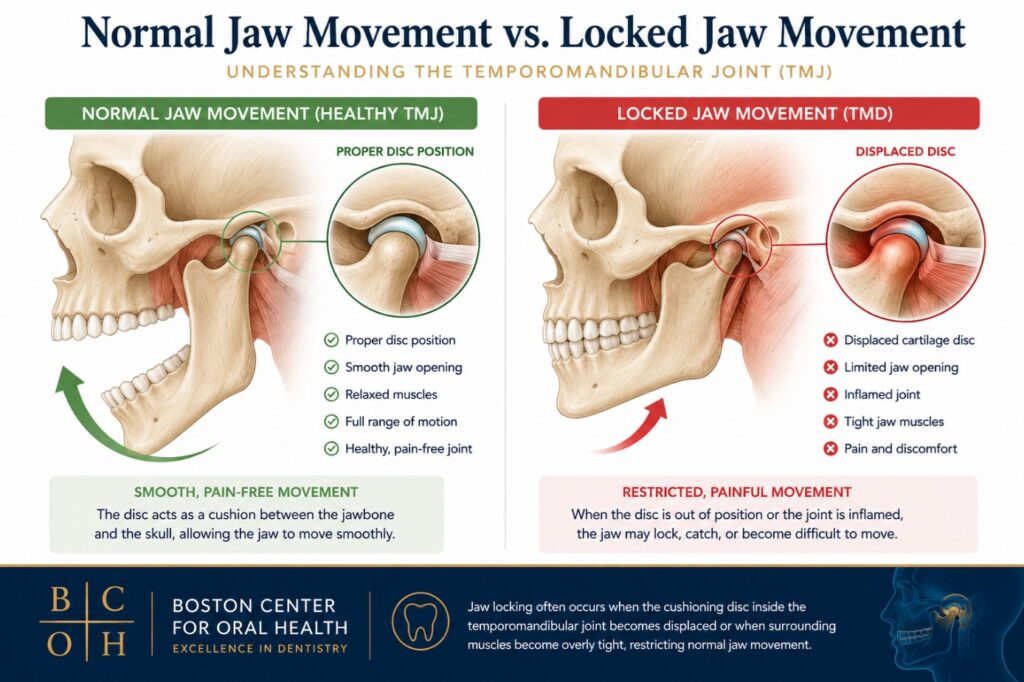
The temporomandibular joints connect your lower jaw to your skull and allow smooth movement when you chew, talk, yawn, or swallow. When the joint becomes inflamed, the cushioning disc shifts out of position, or the surrounding muscles become overly tight, the jaw may temporarily lock or lose its normal range of motion.
Some people experience their jaw locking in the closed position, making it difficult to open their mouth. Others experience the opposite problem, where the jaw locks open and cannot close comfortably. Both situations may indicate an underlying TMJ disorder that deserves professional evaluation.
Jaw locking is frequently accompanied by other symptoms, including jaw pain, clicking or popping sounds, headaches, facial muscle soreness, ear discomfort, and teeth grinding. Identifying the underlying cause is the first step toward finding lasting relief.
Why Does the Jaw Lock?
The temporomandibular joints (TMJ) are complex joints that allow your lower jaw to move smoothly as you chew, speak, yawn, and swallow. Each joint contains a small cartilage disc that acts as a cushion between the jawbone and the skull, helping the joint move comfortably and efficiently.
When this disc shifts out of its normal position, or when the surrounding muscles become inflamed or overly tight, the jaw may no longer move smoothly. Instead, it may catch, click, pop, or temporarily lock during movement. This condition is commonly associated with temporomandibular disorders (TMD).
Some patients experience intermittent jaw locking, where the jaw catches briefly before releasing. Others may develop limited jaw opening, making it difficult to eat, yawn, or speak comfortably. In more severe cases, the jaw can become locked open or closed and require immediate professional evaluation.
Jaw locking is often accompanied by other symptoms, including jaw pain, headaches, facial muscle soreness, ear pain, tinnitus (ringing in the ears), and teeth grinding. Because these symptoms frequently occur together, a comprehensive TMJ evaluation is essential to determine the underlying cause.
Common Causes of Jaw Locking
Jaw locking can result from several different TMJ-related conditions, including:
- Displacement of the TMJ disc
- Inflammation of the jaw joint
- Muscle spasms surrounding the TMJ
- Teeth grinding (bruxism)
- Chronic jaw clenching
- Arthritis affecting the TMJ
- Jaw injury or trauma
- Bite imbalance (malocclusion)
- Long-term stress causing muscle tension
Many patients experience a combination of these factors rather than a single cause.
How Is Jaw Locking Diagnosed?
Jaw locking can result from several different conditions affecting the temporomandibular joint (TMJ). Because the symptoms can resemble other dental or medical problems, an accurate diagnosis is essential before treatment begins.
At Boston Center for Oral Health, we perform a comprehensive TMJ evaluation to determine why your jaw is locking and whether the problem is related to the jaw joint, muscles, bite, or surrounding structures. Our goal is to identify the underlying cause rather than simply treating the symptoms.
During your examination, we evaluate:
- Jaw opening and range of motion
- Jaw joint function and stability
- Clicking, popping, or locking during movement
- Muscle tenderness in the jaw, face, neck, and shoulders
- Bite alignment (occlusion)
- Evidence of teeth grinding (bruxism) or jaw clenching
- Jaw pain, headaches, ear symptoms, and facial muscle tension
- Digital imaging when clinically indicated
A thorough evaluation allows us to determine whether your jaw locking is caused by disc displacement, muscle dysfunction, inflammation, arthritis, or another TMJ-related condition.
Can TMJ Treatment Help Unlock the Jaw?
In many cases, yes. If your jaw locking is related to TMJ dysfunction, conservative treatment may help restore comfortable jaw movement, reduce inflammation, and decrease muscle tension.
Treatment recommendations are based on your individual diagnosis and may include:
- Custom oral appliance therapy
- Bite stabilization
- Treatment for teeth grinding (bruxism)
- Jaw muscle relaxation techniques
- Gentle jaw stretching exercises
- Lifestyle and habit modifications
- Home care recommendations
- Coordination with other healthcare providers when appropriate
Early treatment often helps prevent the condition from worsening and may reduce the risk of chronic jaw dysfunction.

When Should You See a TMJ Dentist for Jaw Locking?
Occasional jaw stiffness may occur after yawning, chewing tough foods, or periods of stress. However, if your jaw repeatedly locks, catches, clicks, or becomes difficult to open or close, it may indicate an underlying temporomandibular joint (TMJ) disorder that should be professionally evaluated.
Many people ignore jaw locking until it begins interfering with eating, speaking, or daily activities. Early diagnosis can often help prevent further joint damage and improve long-term jaw function.
You should schedule a comprehensive TMJ evaluation if you experience the following:
- Jaw locking that occurs repeatedly
- Difficulty opening your mouth fully
- Pain while chewing or speaking
- Clicking or popping that is accompanied by pain
- Jaw stiffness upon waking
- Frequent headaches or facial muscle pain
- Ear pain, ear fullness, or tinnitus
- Teeth grinding or jaw clenching
- A feeling that your bite has changed
Prompt evaluation allows treatment to begin before symptoms become more severe or persistent.
Frequently Asked Questions About Jaw Locking
Why does my jaw lock when I yawn?
Yawning places the jaw in its widest range of motion. If the TMJ disc is displaced or the surrounding muscles are overly tight, the jaw may temporarily catch or lock during this movement.
Is jaw locking a sign of TMJ disorder?
Often, yes. Jaw locking is one of the most common symptoms of temporomandibular disorders (TMD). It may occur when the cushioning disc inside the joint shifts out of its normal position or when inflammation restricts movement.
Can jaw locking go away on its own?
Some mild episodes resolve without treatment. However, recurring jaw locking should not be ignored because it may indicate an underlying joint disorder that can worsen over time if left untreated.
Can stress cause my jaw to lock?
Yes. Stress commonly leads to jaw clenching and muscle tension, increasing pressure on the temporomandibular joints and potentially contributing to jaw locking.
What should I do if my jaw locks open?
Avoid forcing the jaw closed. If your jaw remains locked or you experience significant pain, seek prompt professional evaluation. Repeated episodes should always be assessed by a dentist experienced in TMJ disorders.
Can teeth grinding cause jaw locking?
Yes. Chronic teeth grinding (bruxism) places excessive stress on the TMJ and surrounding muscles, increasing the risk of inflammation, muscle fatigue, and jaw locking.
Is surgery necessary for jaw locking?
Most patients with TMJ-related jaw locking respond well to conservative, non-surgical treatment. Surgery is generally considered only in select cases when less invasive treatments are not appropriate or have not been successful.

Don’t Let Jaw Locking Control Your Life
Jaw locking can be frustrating, painful, and even frightening. Whether your jaw occasionally catches during movement or becomes difficult to open or close, these symptoms should not be ignored. In many cases, jaw locking is a sign of an underlying temporomandibular joint (TMJ) disorder that can often be managed with conservative treatment when diagnosed early.
At Boston Center for Oral Health, we take a comprehensive approach to TMJ care. Rather than focusing solely on the symptoms, we evaluate how your jaw joints, muscles, bite, and surrounding structures work together to identify the underlying cause of your discomfort.
Following a thorough evaluation, we’ll explain our findings, answer your questions, and develop a personalized treatment plan designed to improve jaw function, relieve discomfort, and help you return to everyday activities with greater confidence.
If you’re experiencing jaw locking, limited jaw movement, clicking, or pain, we encourage you to schedule a comprehensive TMJ evaluation.
Related TMJ Resources
Continue exploring our TMJ Education Center:
- Can TMJ Cause Headaches?
- Can TMJ Cause Tinnitus (Ringing in the Ears)?
- Can TMJ Cause Facial Muscle Pain?
- Can TMJ Cause Ear Pain?
- Teeth Grinding (Bruxism)
- TMJ Treatment
- Oral Appliance Therapy for TMJ
(Link each title to its corresponding page.)
References
This page is intended for educational purposes and is based on current clinical knowledge regarding temporomandibular disorders and restricted jaw movement.
Representative references include:
- American Academy of Orofacial Pain (AAOP)
- National Institute of Dental and Craniofacial Research (NIDCR)
- American Dental Association (ADA)
- Peer-reviewed literature on temporomandibular disorders, disc displacement, and jaw dysfunction
Restore Comfortable Jaw Movement
If jaw locking, clicking, limited jaw movement, or TMJ pain is affecting your daily life, a comprehensive TMJ evaluation can help identify the cause and guide you toward lasting relief.
📞 Call 617-536-4620
